A research study flyer may be the first thing a participant learns about your study, so many IRBs review it before it goes up. Grad students, labs and clinics post them on campus boards, in waiting rooms and on department screens. Below: the details to include, wording by study type, a survey flyer, design for campus boards, and how to draft one in Flyer Maker before your IRB signs off on the final text.
What to put on a research study flyer
Keep the flyer to what a reader needs to judge whether they qualify and want to take part: who runs the study and where, its purpose or the condition studied, a short eligibility summary, the time it takes, and whom to contact. Build yours in this order.
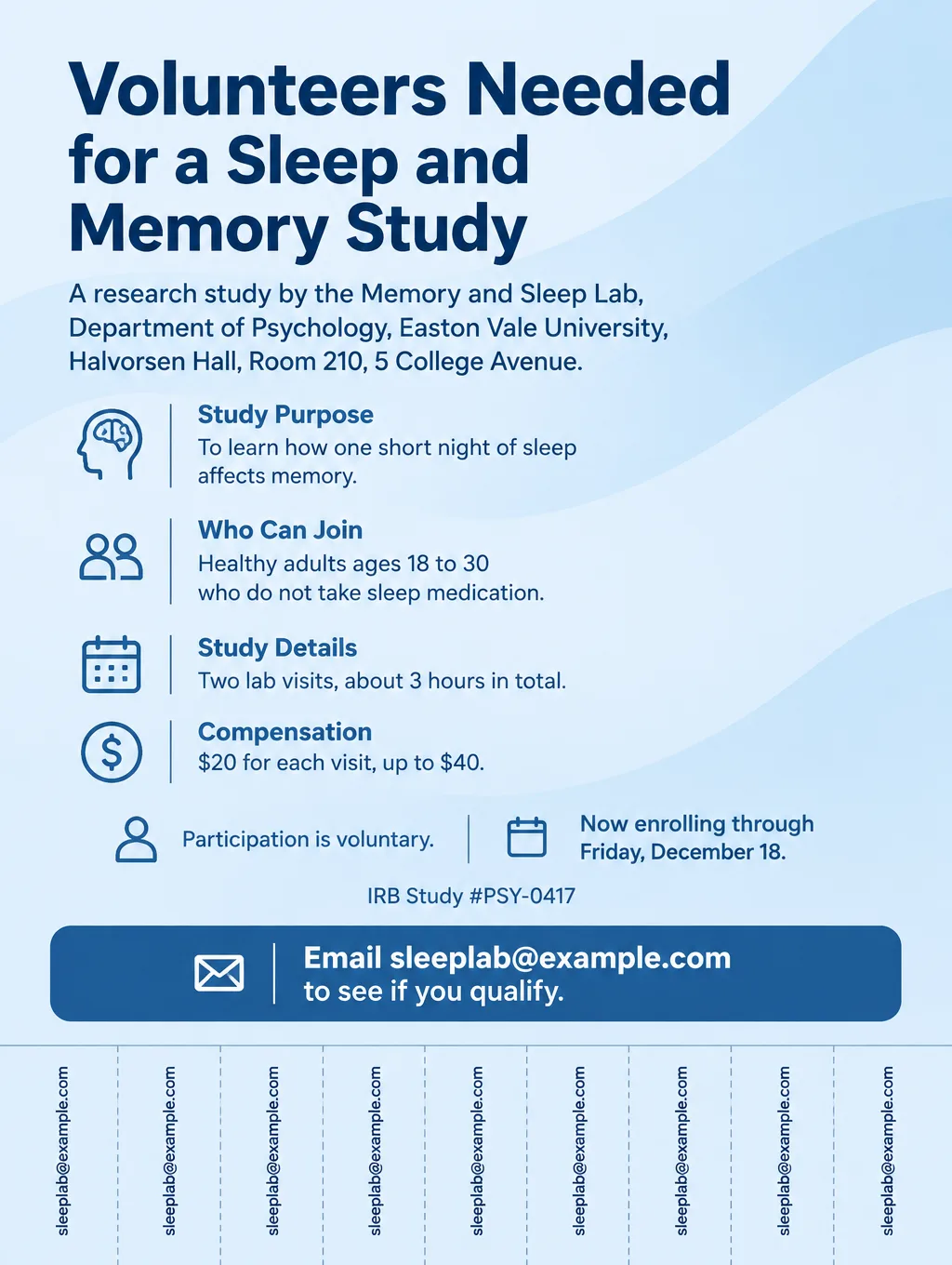
- "Research" in the headline. "Volunteers Needed for a Research Study on Sleep and Memory" says what it is up front.
- The purpose, in plain words. "To learn how one short night of sleep affects memory."
- Who can take part. A two-line summary, such as "Healthy adults 18 to 30 who don't take sleep medication". The full criteria belong in the screener.
- What participants do. "Two lab visits: a memory test, a night at home, then a second test."
- Time commitment. "About 3 hours in total over one week."
- Where. The building and room, or "online, from any phone or computer".
- Compensation, in regular type. "$20 for each visit, up to $40." Keep it the same size and weight as the lines around it. A per-visit amount tells people what they get even if they stop early, which one lump sum for finishing doesn't.
- Who runs it. The lab or department and the principal investigator.
- Contact and screener. A study email or phone line, plus a screener link or QR code.
- "Participation is voluntary." Add "You can stop at any time" if your consent form says so, and use the wording your IRB approved.
- The IRB line. The study number and approval date, in the form your IRB tells you to use.
- Tear-off tabs with the study email, for paper boards.
Leave off lines that read like a promise: claims or hints that a product is safe or works, "new treatment" or "new drug" without saying it's investigational, and "free medical treatment" when all you mean is that the study costs participants nothing.
Research study flyer ideas and wording
These research study flyer examples cover eight common study types. The labs, amounts and study numbers are invented.
| Study type | Headline | Supporting line |
|---|---|---|
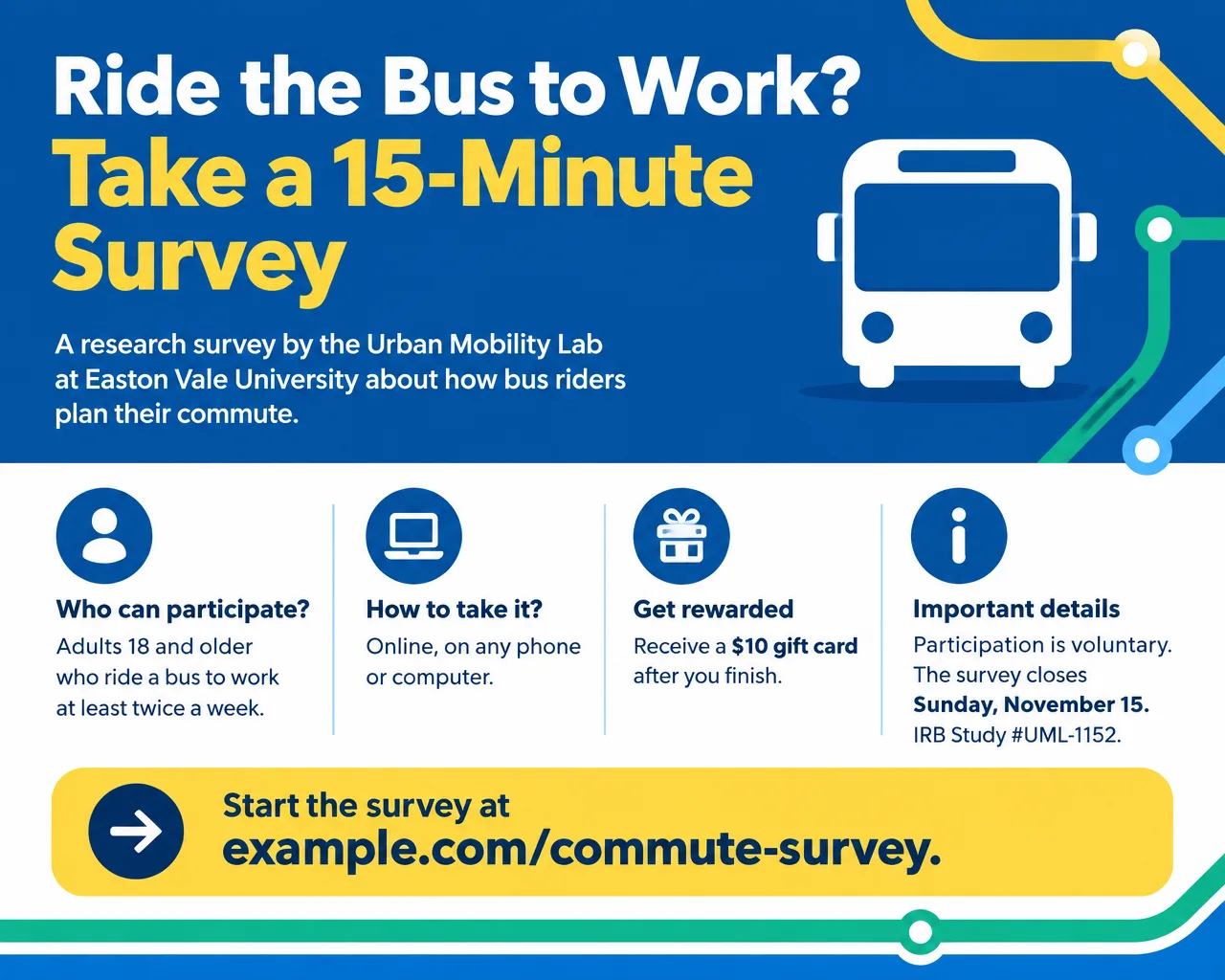
| Online survey | "Share Your Commute: 15-Minute Online Survey" | "Adults who ride the bus to work. Receive a $10 gift card." |
| Sleep or memory lab study | "Volunteers Needed for a Sleep and Memory Study" | "Healthy adults 18 to 30. Two lab visits, about 3 hours total." |
| Interview study | "Parents of Toddlers: Tell Us About Bedtime" | "One 45-minute interview by phone or video. $30 gift card." |
| Focus group | "Join a 1-Hour Focus Group on Campus Dining" | "Undergraduates in any year. Snacks and a $20 gift card." |
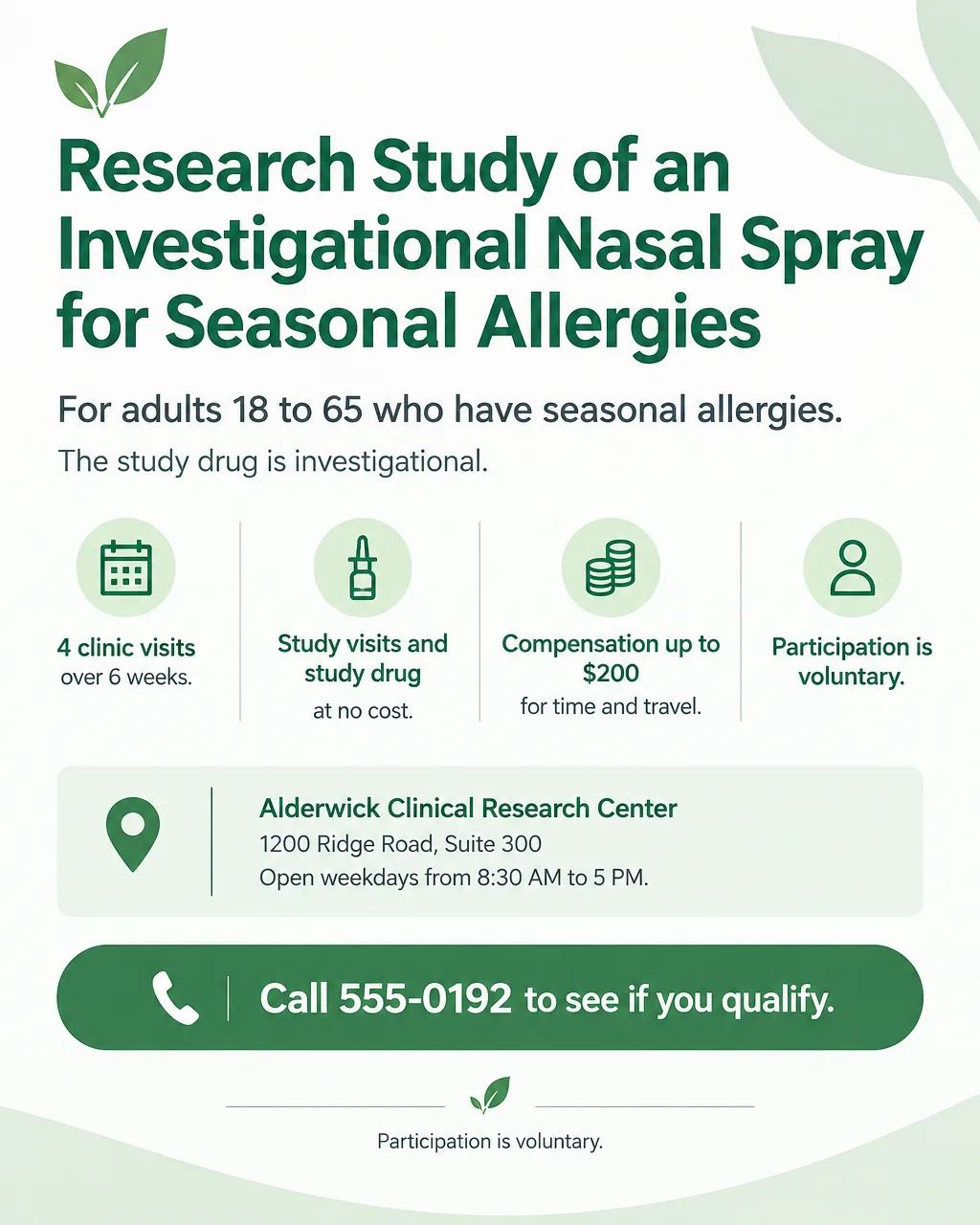
| Clinical research | "Research Study of an Investigational Nasal Spray" | "Adults 18 to 65 with seasonal allergies. 4 clinic visits over 6 weeks." |
| Usability test | "Test a Website Prototype for 30 Minutes" | "On campus or online. $15 gift card for your time." |
| Child development | "Families with Babies 6 to 12 Months" | "One 45-minute play-based visit. A parent stays with the baby throughout." |
| Activity or health study | "Research Study for Adults Who Sit Most of the Day" | "Wear an activity tracker for 2 weeks. Up to $50 for your time." |
Three wording habits for recruitment flyers:
- Write "investigational" for any drug or device that isn't approved, and say what it means in a short clause.
- Call payment "compensation for your time", in the same type as the rest. Payment thanks people for their time rather than being a benefit of the study, so it doesn't go under "benefits".
- Stop eligibility at two or three lines. A screener handles the rest, and a shorter flyer is easier to read from a hallway.
A flyer for a survey
A flyer for a survey has one job: get someone to open a link. Put the topic, who qualifies, the length in minutes, any incentive and the closing date in large type, then print both a scannable code and a web address short enough to type. Write "anonymous" only if the survey collects nothing that identifies a person, and match every word to your consent page.
Info sessions and study events
Some studies hold a group info session or an open house for participants. That flyer works like a class announcement, and the workshop and class flyer page has wording for seats, times and sign-ups. A booth at a community health fair or campus event follows the event flyer checklist instead.
Design tips for research study flyers
Write the headline for a hallway. "Volunteers Needed" plus the topic in the top third, so a student walking past can tell what the study is about in two steps.
Keep payment in body type. Some IRBs review the final print copy, type size included. A dollar amount in the biggest, boldest type makes the flyer read like an ad for money rather than a study.
Give passersby a tab to take. Ask for a strip of tear-off tabs at the foot of the flyer with the study email on each, for people who don't scan codes.
Pair the QR code with a short link. Flyer Maker can leave an empty square for the code; drop your real screener code into it and print the short link underneath. See how to test a QR code at print size before you post.
Pick neutral pictures. An abstract pattern or a small icon (a moon for sleep, a speech bubble for interviews) fits. Skip images of happy, healed patients, which can read as a promised result.
Use your university logo the approved way. "Add your logo" usually places a logo small, in the header or footer. Use the version your university's brand rules allow, and ask your department if you're unsure.
Leave a corner for the IRB stamp. If your IRB stamps approved flyers, keep one corner free of text.
Research study flyer sizes and printing
Campus recruitment usually needs one printed size and one wide screen version.
| Recruitment spot | Paper or screen | Pixels needed at 300 DPI | Flyer Maker size |
|---|---|---|---|
| Campus board or clinic waiting room | Letter, 8.5 x 11 in | 2550 x 3300 | Tall, 4K |
| Busy hallway or student union | Tabloid, 11 x 17 in | 3300 x 5100 | Tall, 4K |
| Department screen or listserv email | 5:4 landscape | Screen only | Wide, 2K |
GotPrint's FAQ puts 11 x 17 next to 4 x 6 and half letter when it names its most popular flyer sizes. A 3:4 design on 11 x 17 paper leaves unprinted strips along the top and bottom edges, a natural place for the IRB stamp if yours uses one. For printing, choose 2K or 4K, and print from the exact file your IRB approved. More paper sizes are in the guide to flyer dimensions.
Common research study flyer mistakes
- Changing the flyer after approval. Ask your IRB before you post a new version. An AI tool gives a new design every time, so submit the exact image you plan to post.
- Payment as the headline. "$200" in giant type in the middle of the flyer.
- "Free treatment" or "new drug". Write "at no cost to you" and "investigational" instead.
- A wall of eligibility criteria. Ten bullet points in small type get skipped. Summarize and link the screener.
- Posting without checking the building's rules. Ask the department office or student union where recruitment flyers can go and whether they need a posting stamp.
More research study flyer prompts
Research study flyer. Headline: "Parents of Toddlers: Tell Us About Bedtime". A research study by the Family Sleep Lab, Department of Human Development, Easton Vale University. One 45-minute interview by phone or video about bedtime routines, scheduled weekdays or evenings through Friday, December 11. For parents of children ages 1 to 3. $30 gift card for your time. Participation is voluntary. IRB Study #HD-2207. Call to action: "Email familysleep@example.com to see if you qualify." Calm, soft layout with a small moon and star icon.Research study flyer. Headline: "Join a 1-Hour Focus Group on Campus Dining". For undergraduates in any year at Easton Vale University. Sessions on Tuesday, November 17 and Thursday, November 19, 5 to 6 PM, Student Union Room 204, 1 University Drive. Snacks and a $20 gift card. Participation is voluntary. A study by the Department of Nutrition Sciences, IRB Study #NS-0931. Call to action: "Sign up at example.com/dining-study." Friendly, clean design with a simple fork and speech bubble icon.How to make a research study flyer in Flyer Maker
- Begin with your IRB-approved wording, or the draft you'll submit. Paste it into "Describe your flyer" in Flyer Maker, with the exact headline, purpose, eligibility, time, place, payment, voluntary line, IRB line and call to action.
- Pick Tall for boards and waiting rooms, or Wide for department screens and email.
- Set the Flyer type to Announcement under "More options". Minimal or Corporate style, Light colors and a Serious tone suit most studies.
- Enter the study email or phone in "Contact info".
- Turn on "Leave a blank square for your QR code" if you link a screener, then place your real code in it.
- Tap "Create flyer". The study flyer takes about 30 seconds.
- Hold the result up against your approved text, line by line. Flyer Maker can fill a gap with a tagline of its own, and the payment line must not be larger or bolder than the rest. Correct anything in "Want to change something?" (currently 60 credits, 70 at 2K, 90 at 4K), then send the final image to your IRB as its own version.