
Schools, churches, clinics, landlords and employers make a Spanish flyer when many of the people they need to reach read Spanish first. Those readers spot a date, a time or a missing ¿ that was written the English way. Below is Spanish wording for hiring, lost pet, trunk or treat and event flyers, the date, time and punctuation rules to follow, four bilingual layouts, and the checks to run before you print.
What to put on a Spanish flyer
A Spanish flyer carries the same facts as an English one, in Spanish order and style:
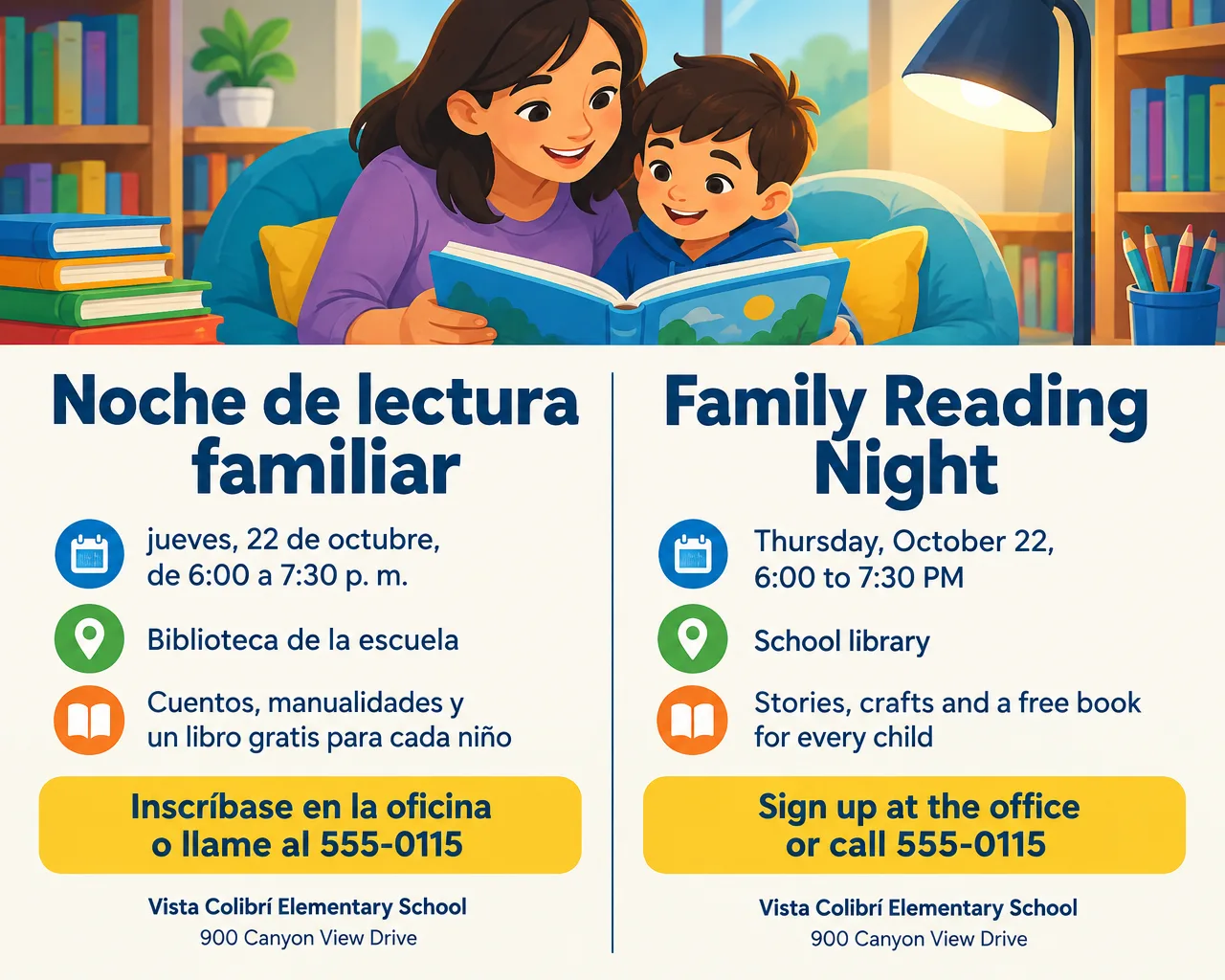
- The name of the event or offer in Spanish. "Noche de lectura familiar". Keep an English name only when that's what people call it, such as "Trunk or Treat".
- The weekday and date, day before month. "sábado, 17 de octubre", with a comma after the weekday.
- Times with a. m. and p. m. "de 6:00 a 7:30 p. m."
- The address exactly as it's posted. Don't translate street names: "415 Elm Street" stays "415 Elm Street".
- The price, or "gratis". "Entrada gratuita" or "Gratis para niños".
- Who it's for. "Para toda la familia" or "Niños de 5 a 12 años".
- How to respond, with a contact who speaks Spanish. "Llame a la oficina al 555-0115. Se habla español."
- Every accent and both marks, ¿ and ¡. "¿Ha visto a Canela?" and "¡Acompáñenos!"
- Your name and logo, the same as on your English flyers.
The University of Wisconsin Division of Extension's language access team gives similar advice for bilingual event flyers: keep it to one page, limit the text to the essentials (who, what, where, when, why), set the two languages side by side in two columns, and list a specific contact person, preferably a bilingual one.
How to write dates, times and punctuation in Spanish
These are the details that mark a flyer as translated by someone who doesn't write Spanish. The rules below come from FundéuRAE, a nonprofit Spanish-usage foundation backed by the Real Academia Española and the news agency EFE:
| English | Spanish | Rule |
|---|---|---|
| Saturday, October 17 | sábado, 17 de octubre | Day before month, with "de" between them; weekdays and months are lowercase unless they start the text |
| Sunday, November 1 | domingo, primero de noviembre | For the 1st, "primero" is the form preferred in the Americas; "uno" is more common in Spain |
| 10/17 | 17 de octubre | Numeric dates go day first in Spanish, so spell out the month rather than risk "10/17" |
| 7:30 PM | 7:30 p. m. | Write "a. m." and "p. m." with a period after each letter and a space in the middle, not "am" or "pm" |
| 9:15 AM | 9:15 a. m. | A colon is the standard separator between hour and minutes; a period is also correct |
| Noon | 12 m. | "m." (mediodía) is the recommended form for 12 noon |
| 9 in the morning | las 9 a. m., or las nueve de la mañana | Don't mix numbers with words, as in "las 9 de la mañana" |
| "Have you seen this dog?" | "¿Ha visto a este perro?" | Open the question with ¿ |
| "Join us!" | "¡Acompáñenos!" | Open the exclamation with ¡ |
The opening marks do real work. FundéuRAE, citing the writer José Antonio Millán, notes that the Real Academia first recommended them in its 1754 spelling rules, because the same Spanish sentence can be a statement, an exclamation or a question: "Está abierto." and "¿Está abierto?" differ only in the marks, and the ¿ tells the reader from the first word. A weekday takes a capital only where any word would, such as at the start of a headline: "Sábado, 17 de octubre" on top, "el sábado, 17 de octubre" inside a sentence.
Pick "usted" or "tú" and keep it. "Llame hoy" and "Inscríbase" (usted) suit businesses, schools and clinics; "Llama hoy" and "Ven" (tú) suit a youth night or a party.
Spanish flyer wording by occasion
The lines below use fictional names, dates and phone numbers. Change them, and have a fluent speaker read your final version.
Now hiring flyer in Spanish
- Headlines: "Estamos contratando", "Se busca personal", "Únase a nuestro equipo"
- Supporting line: "Cocineros y cajeros. De $17 a $20 por hora. Horario flexible."
- Call to action: "Solicite en persona de lunes a viernes, de 2:00 a 4:00 p. m."
FundéuRAE notes that "aplicar" in the sense of applying for a job was added to the Spanish dictionary in December 2019 and is widely used in the Americas, so "Aplique hoy" is correct, and "Solicite hoy" is the traditional alternative. Pay-range laws apply to a hiring flyer in Spanish exactly as they do in English; the hiring flyer guide covers which states require the range to be printed.
Lost dog flyer in Spanish
- Headlines: "Perro perdido", "Perrita perdida", "¿Ha visto a Canela?"
- Supporting line: "Se perdió el martes, 20 de octubre, cerca de Elm Street y 5th Avenue. Hembra, pelo café, collar rojo."
- Call to action: "No la persiga. Llame al 555-0149. Se ofrece recompensa."
A lost pet flyer needs a real photo of the dog, so it's built differently from the other flyers here; the lost dog flyer page shows how. Match "perro" or "perrita", and "lo" or "la", to your dog.
Trunk or treat flyer in Spanish
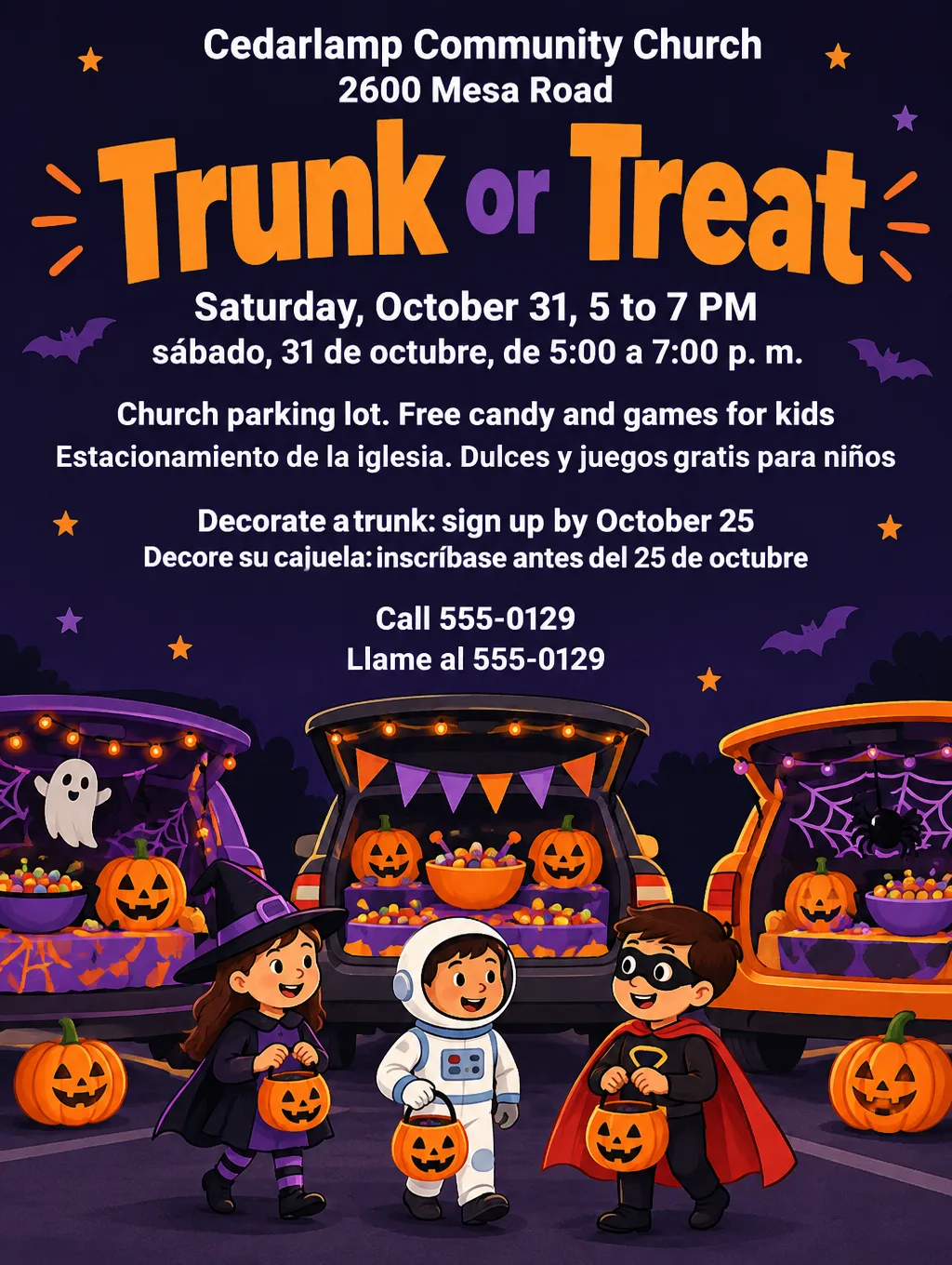
- Headlines: "Trunk or Treat", "Fiesta de otoño y Trunk or Treat"
- Supporting line: "sábado, 31 de octubre, de 5:00 a 7:00 p. m. Estacionamiento de la iglesia. Dulces y juegos gratis."
- Call to action: "¿Quiere decorar su cajuela? Inscríbase antes del 25 de octubre."
You can keep the English name and explain it in Spanish: "Los niños piden dulces de cajuela en cajuela." If your families say something other than "cajuela" for a car trunk, use their word. The rest of the event, such as a rain plan, is covered in the trunk or treat flyer ideas.
Event flyer in Spanish
- Headlines: "Noche de cine familiar", "Feria de salud comunitaria", "Venta de garaje"
- Supporting line: "viernes, 16 de octubre, a las 7:00 p. m. Traiga su silla. Entrada gratuita."
- Call to action: "Más información: 555-0115."
For the checklist behind any community event, see the event flyer page; the details are the same in both languages.
Bilingual flyer layouts
Bilingual flyers put both languages on one sheet, so one flyer on a board reaches both groups. Four common arrangements:
| Layout | How it works | Suits | In Flyer Maker |
|---|---|---|---|
| Side by side | Spanish column on one side, English on the other | Short event details, school notices | Wide size, "Split" layout |
| Line by line | Every English line with its Spanish version right below it | Hiring and lost pet flyers with few lines | Tall size, "Centered" layout |
| Top and bottom | One language on the top half, the other below | Flyers with one shared picture | Tall size, "Clean" layout |
| Two versions | A separate flyer in each language | Menus, long notices, jobs with many requirements | Two flyers |
Whichever you choose, give both languages the same type size and the same position of importance. A Spanish line set smaller than the English one reads as an afterthought to the people you made it for.
Flyer translation to Spanish: what to check
A word-for-word flyer translation from English tends to produce the errors below. Check each one before printing:
- "Free" is "gratis" or "gratuito", not "libre". "Libre" means unoccupied or free as in liberty.
- "Sale" is "venta" or "oferta". A yard sale is often "venta de garaje".
- Leave names and numbers alone. Street names, business names and phone numbers stay exactly as they are.
- Check gender agreement. "Todos son bienvenidos" for a mixed group, "perrita perdida" for a female dog.
- Ask someone local. Vocabulary changes by country, and the person who answers the phone should approve the wording people will call about.
- Read the flyer aloud in Spanish. Reword any line that trips you up.
Design tips for Spanish and bilingual flyers
Leave room for longer lines. "Inscríbase antes del 25 de octubre" is longer than "Sign up by October 25". Write the Spanish first, then check that the layout fits it without shrinking the type.
Put "Se habla español" next to the phone number, and only when the person who answers really speaks Spanish.
Check accents at the size you'll print. At small sizes, "é" can look like "e" and "ñ" like "n". Print one copy and read it at arm's length.
Share one picture between languages. One illustration across the top, as the University of Wisconsin team suggests with its banner photo, ties both columns together and leaves room for text.
Keep the headline in both languages at the same size. If only one headline fits, lead with the language most of your readers use, and repeat the key word in the other.
Spanish flyer sizes
Bilingual flyers hold twice the text, so they need the full page. Use a letter page (8.5 x 11 inches) for boards and doors. Flyer Maker's Tall size at 4K (2480 x 3312 pixels) fills that page at close to 290 pixels per inch once about a third of an inch is trimmed from its length. For a side-by-side flyer, Wide (5:4) gives each column more width and prints landscape at 4K (3200 x 2560 pixels, 10.7 x 8.5 inches at 300 pixels per inch). For Facebook groups and WhatsApp, use Portrait at 1K.
How to make a Spanish flyer in Flyer Maker
- Settle the Spanish wording first, checked by a fluent speaker. If you're starting from nothing, AI Writer (5 credits, Free plan) can draft short ad copy in English from your details for someone to translate.
- Paste the finished wording into Flyer Maker's "Describe your flyer" box, each Spanish and English line in quotation marks, and say where each language goes ("Spanish column on the left, English on the right, same size type").
- Choose a size: Wide for side by side, Tall for line by line, Portrait for social posts.
- Set the Layout under "More options": "Split" for two columns, "Centered" for paired lines. The phone number goes in "Contact info".
- Tap "Create flyer" and give it about 30 seconds.
- Proofread every accent, ¿ and ¡, and each date and weekday. Flyer Maker renders Spanish accents correctly, but it has no language setting or translate option, and it may add a slogan of its own in the gaps. A wrong line can be corrected in "Want to change something?" below the result, at a current 60 credits (70 for 2K, 90 for 4K).
- Have your fluent reader check the printed copy before you make more.
A flyer currently costs 80 credits at 1K, 90 at 2K or 100 at 4K; pricing lists plans and top-ups.